Active Discovery in the Age of AI

In a 2024 study published in Nature, researchers noted that there’s been an increase in boredom in young people over the past several years. As they’re discussing their findings, they bring up the role of digital media in this phenomenon. Now, one might expect digital media to take some of the stress off boredom, but surprisingly, the opposite seemed to be true. Digital media use was positively correlated with boredom. This finding defies intuitive logic: how can unlimited entertainment produce more boredom?
We’ve never had access to so much entertainment and media before— yet it seems like in spite of this, we’ve also never been quite so bored. Even shows can’t seem to keep our attention anymore, as companies like Netflix are designing content with the expectation that it will merely be playing on a “second screen” as people search for additional stimulation elsewhere. It’s easy to blame this simply on shrinking attention spans and poor self-discipline, but underneath that, something else seems to be at play: we are bored because everything feels too tailor-made. Standing out in this media ecosystem will require companies to adapt to the changing ways that people are discovering the ideas, brands, and art that matters to them.
Algorithmic Monotony
Algorithmic monotony is a phenomenon that tech critics have been tracing for years now. As writers have argued, much of our contemporary boredom can be traced back to the current reign of algorithmic distribution— which has flattened tastes and channeled discovery along safe, predictable lines. Where online discovery used to be an active process of exploration and inquiry and encounters with the unknown, algorithms have transformed it largely into a process of passive consumption in which you don't find things, things find you. The problem is, these algorithms optimize for engagement, not delight or surprise, and they end up serving users more of what they’ve already liked, creating filter bubbles that feel simultaneously personalized and monotonous. The longer we spend in this ecosystem, the more that the predictability of algorithmic content has made entertainment feel unsurprising, the more bored we get.
The Bifurcation of Discovery
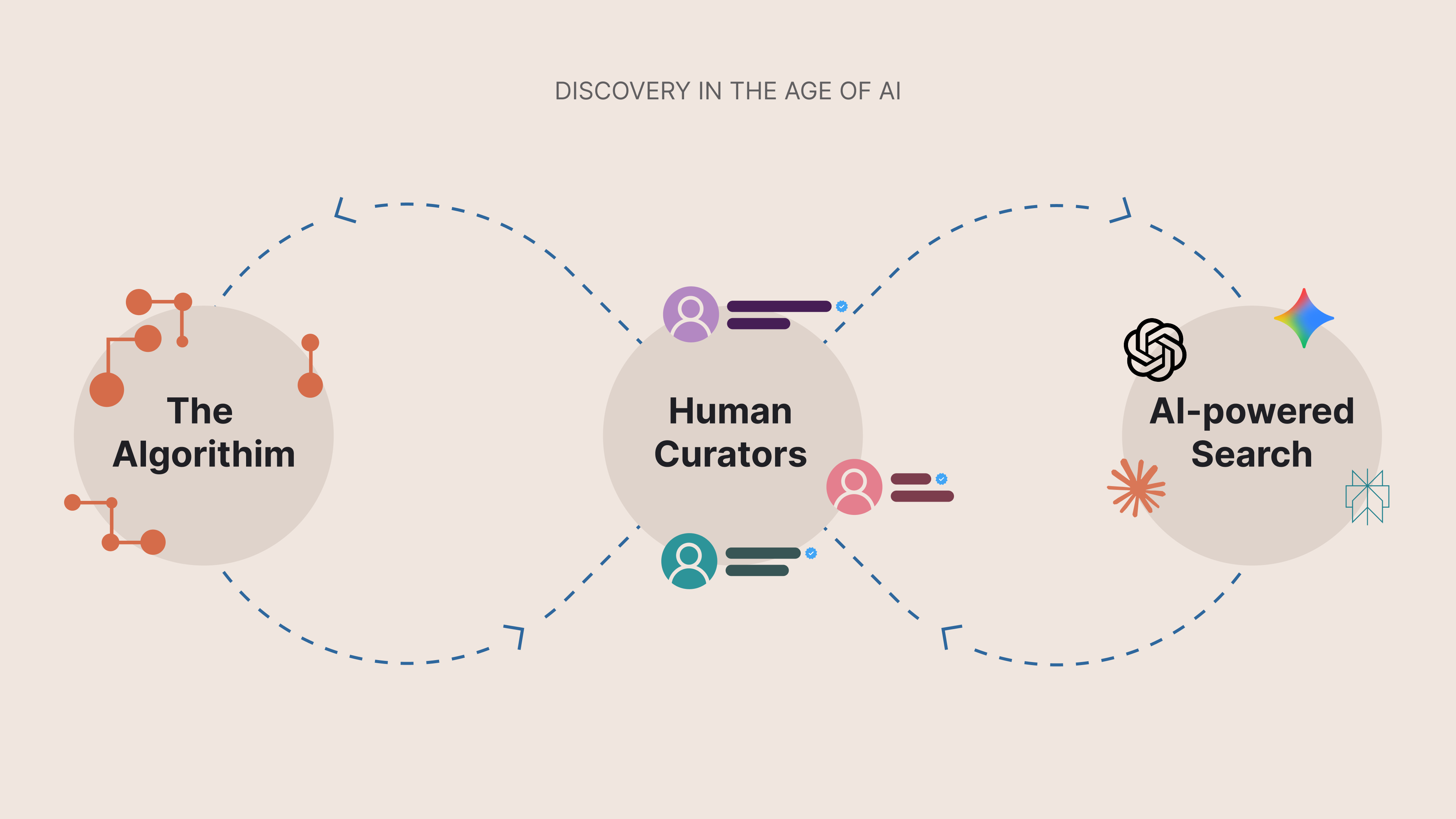
As people get frustrated with this current approach to discovery, we’re beginning to see the discovery process bifurcate. On the one hand, safe, algorithm-led discovery is (and will undeniably continue to be) the dominant way people engage with online life. This will manifest as a sort of ongoing process, where people are fed things that they’ll probably like according to the ways that the algorithm classifies their tastes/personas. This mode is efficient, reliable, and fundamentally conservative—it surfaces what's already validated, already popular, already safe. It’s also a mode that will likely be bolstered by the continued integration of AI—not just through continued refinements in the distribution algorithm used to populate the feed, but through agents that preemptively curate content based on your behavior across platforms.
Yet when it comes to the desire to break out of boredom— to come across the unexpected, the surprising— and cultivate the kind of perspective that provides you with cultural capital, we’re seeing a new model of active discovery emerge. This model centers individuals: real-people who can give recommendations that aren’t driven by algorithmically optimized alignment, but by personal and idiosyncratic taste. It’s why offerings like NTS— an online radio station— have gained a substantial following by featuring DJs with eclectic and niche tastes. Though people might still go to Spotify for the muzak they listen to where they go about the day, platforms like NTS are creating opportunities for people to discover the unexpected: the obscure Japanese city pop track, the underground Detroit techno producer, the forgotten '70s Brazilian jazz fusion. It also helps us make sense of the rise of the “internet curator” on platforms like TikTok and IG. The appeal of this mode isn’t that these recommendations are "good,” it's that they're unpredictable, opinionated, and carry the mark of a real person's sensibility.
This has been a boon for platforms that feature authentic individual perspectives (like Reddit and Substack as well as new entrants like Perfectly Imperfect) as people are increasingly turning to spaces where they feel like they can get real recommendations from real people— rather than discovery that’s been paid for through advertising dollars. The value of these recommendations isn’t that they’ve been pre-sorted to fit your tastes, it’s that they’re contextual, nuanced, and argumentative and come with explanations, caveats, and passionate defenses that algorithmic suggestions never provide.
It’d be wrong, however, to think that algorithmic or predictive technologies don’t play a role in this active model. What distinguishes this emerging active discovery process from the sort of active discovery of the pre-algorithmic era of micro-blogs and niche digital communities is its hybrid nature. After all, users are finding many curators and tastemakers in the first place through the algorithm (making these accounts meta-algorithm breakers that use the algorithm to distribute anti-algorithmic taste). And for many savvy users, once they’ve found something new, they’re using tools like AI to help them find more of the same—creating a positive feedback loop where they can explore the new things they’ve encountered through these taste-led channels. This creates a mixed discovery model in which humans provide the initial spark of novelty, and AI allows for efficient expansion and exploration of that territory.
Looking Forward
What we're witnessing is a broader cultural reckoning with the promise of hyper-optimization. The rise of active hybrid discovery suggests people are hungry for something else: surprise, friction, the possibility of not knowing what they'll like until they encounter it. There’s a reason, for instance, why we’ve seen the resurgence of brand-backed magazines in recent years (from companies like Feeld, Stripe and Mozilla Foundation) as brands have leaned into their roles as cultural curators with a distinct editorial perspective; people don’t just want brands to introduce them to their products, but a broader world of ideas, content, and tastes. We also see this impulse play out in the rise of mystery boxes by brands as diverse as Set Active and Le Creuset that appeal to this desire for the unknown. As this appetite for novel perspective grows, we're likely to see new platforms and services built around this principle: not 'here's what you'll love' but 'here's what you'd never think to look for.'